 Sollerets 1189-1199
Functionality
In order to keep their feet from slipping out of stirrups, the knights of King Richard the Lionhearted, began to wear sollerets. These shoes were downward curving shoes made of brass and steel. As seen in this example, shoes were first modified to enhance functionality.
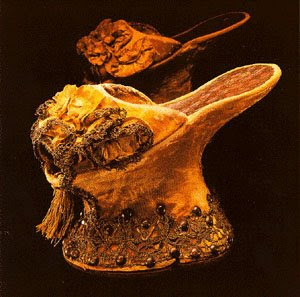 Chopines, circa 1500
Height as a way of life
This shoe style originally known as “chopines” was first popular among women in Italy, Spain and France. The style featured pedestals made of cork or wood and could have been as high as 24 inches. One extreme example known is of a Venetian lady whom while wearing chopines, needed two servants to help her in and out of her gondola. This example definately kept gowns from getting dirty from the mud - a sign of functionality. However, I see a bit of extremity in the height of the shoe which leads me to believe that at this time, people wanted some flair in their style.

 Pompadour Heels/Louis Heels 1638-1715
 Modern tech – circa 2008
Modern Heels
Modern day shoes have become taller then ever before, with 5 to 6 or even 7-inch heels and platforms. Besides the increase in height, designer shoes have inclined in expense. They range from $100 versions sold by brands such as Steve Madden to between $600 and $1,500 from designers such as Yves Saint Laurent, Marni, Manolo Blahnik and Christian Louboutin. Adopting characteristics from its ancestors, the modern shoe incorporates spiky stilettos, tapered cones, sloping wedges and thick wooden posts.
This shoe style originally known as “chopines” was first popular among women in Italy, Spain and France. The style featured pedestals made of cork or wood and could have been as high as 24 inches. One extreme example known is of a Venetian lady whom while wearing chopines, needed two servants to help her in and out of her gondola. This example definately kept gowns from getting dirty from the mud - a sign of functionality. However, I see a bit of extremity in the height of the shoe which leads me to believe that at this time, people wanted some flair in their style.

A modern trend lending its style from history: The First High Heel and The D’Orsay, 1533
(shown: Manalo Blahnik, circa 2007)
(shown: Manalo Blahnik, circa 2007)
Introduction of mainstream high heeled shoes
Catherine d’Medici, an Italian, married the Duke of Orleans at the age of 14. She was known to be of short stature and as such wore shoes with two-inch heels to exaggerate her height on her wedding. Her wedding style set off a trend for other shortly statured nobles across Europe. The Queen of England, who was also short in stature, is also thought to have made this trend en vogue.
As the high heel evolved, an interpretation of the heel included side openings that actually appeared in the 19th century English style, becoming popular in courts. Considered sensuous, the desire to expose skin on women’s feet led to the creation of the “d’Orsay” style. The d’Orsay is the style of shoe in which the vamp and sides are cut away to reveal the instep of the foot. The high heel is thought to have been invented by Leonardo da Vinci (1452-1519)
 Pompadour Heels/Louis Heels 1638-1715
The Origin of the French Heel
At first, shoes with higher heels were made to allow ladies to walk high enough off the ground so that their skirts could be kept out of the mud. However, more than 100 years after Catherine de Medici first introduced high heels as a fashion statement, French heels were developed to help a man get over his Napoleon complex!
At first, shoes with higher heels were made to allow ladies to walk high enough off the ground so that their skirts could be kept out of the mud. However, more than 100 years after Catherine de Medici first introduced high heels as a fashion statement, French heels were developed to help a man get over his Napoleon complex!
An example of an aristocrat using the style of his show to achieve greater height is King Louis XIV. King Louis XIV was a considered to be a short man. In order to achieve a height he considered reputable, he wore special high heels. The heels themselves were made of cork and also covered with dyed red leather. His shoes were painted with scenes from his military triumphs. Because of his influence, sometimes French heels are also referred to as Louis heels. They are five inches tall and bent so that they came down from the back of the heel, inward toward the shoe, and then outward away from the shoe for a winding look.
The influence of King Louis’ shoe choice can be seen today, but with modifications. Today, many French heels are made from plastic instead of cork. The upper part of the shoe is made of plastic, leather or fabric, while the sole is made of a hard plastic material. Some French heels have maintained the curved heel shape, but on a smaller scale.
The influence of King Louis’ shoe choice can be seen today, but with modifications. Today, many French heels are made from plastic instead of cork. The upper part of the shoe is made of plastic, leather or fabric, while the sole is made of a hard plastic material. Some French heels have maintained the curved heel shape, but on a smaller scale.
 Modern tech – circa 2008
Modern Heels
Modern day shoes have become taller then ever before, with 5 to 6 or even 7-inch heels and platforms. Besides the increase in height, designer shoes have inclined in expense. They range from $100 versions sold by brands such as Steve Madden to between $600 and $1,500 from designers such as Yves Saint Laurent, Marni, Manolo Blahnik and Christian Louboutin. Adopting characteristics from its ancestors, the modern shoe incorporates spiky stilettos, tapered cones, sloping wedges and thick wooden posts.


 Left:


