Sunday, April 19, 2009


Dress, Egyptian inspired, by Sophia Kikosalaki, 2009


New Kingdom tomb painting, approximately 159 BC (top);
Egyptian inspired artwork, date unknown (below)


Egyptian


The Egyptian cave painting (below) and artwork (above) reflect the simple sheer gowns of the New Kingdom (approximately 159 BC to 30 BC) when ancient Egypt was conquered by Rome. Men and women draped large pieces of fabric in intricate ways around their bodies. Garments resembling straight caftans were at times richly decorated, displaying pleats held by pins and belts. This tying method had the effect of creating wide, elbow-length sleeves. In this example, pleating and one shoulder style is seen in the Sophia Kokosalaki's creation in white. Her dress imitates the sheer qualities of the tomb artwork, and also focuses on the linear form.


Photograph, 20th century(top);
Byzantine

During the 11th century, the mixing of elements from Roman classicism with Middle Eastern ornamentation resulted in the Byzantine style. This costume consisted of detail and intricacies within the overall composition of the garment, such as embroidered fringe at hems, cuffs and neckline. In addition, jewels could be attached to anything so that any accessory could become the primary element of the garment. In the example below, the illustration shows how different colored fabrics were used, creating the introduction of the “Mi-Parti” method. Pants were tightened, while being covered with long or knee-length skirts. The photograph above shows a religious figure who is wearing a Byzantine inspired garment in the 20th century.


Magazine Print depicting 11-12th century Byzantine fashion (below)


Marie Antoinette, 18th century (top); Dolce & Gabana pseudo 18th century style, circa 2008 (bottom)

Rococo
The painting of Marie Antoinette’s 18th century fashion demonstrates the influence of Baroque style on what came to be known as Rococo. This style incorporated ornate detail and a sense of indulgence. The lavish dress code of the Rococo era included lowered necklines as well as towering hairstyles. As seen in a modern interpretation of Rococo style, Dolce & Gabana have attempted to mimic the textiles and embellishments of that era in their own work.


Portrait of Madame de Verninac; 1798–1799 by Jacques Louis David


Portrait of Madame Emilie Seriziat and her Son; 1795 by Jacques Louis David (bottom)

Neoclassical

These portraits show examples of Neo-classic era trends. The simple dress style is characterized by unornamented, all white fabric; given contrasting sashes. Both styles have a thin and flowing outer layer constructed of sheer fabric, imitating ancient Greek and Roman fashion. Madame Seriziat is seen fully skirted and wearing a corset. Over her indoors cap is another hat. As seen on the right, (on Madame de Verninac) neo-classicism introduced the Empire silhouette.

Agatha Ruiz De la Cruz, Milan Fashion Week, 2009

Surrealism

Beginning in the early 1920s, Surrealism is a cultural movement that stemmed from Dadaism after World War I. Surrealist work (including fashion) incorporates elements of surprise and unexpected juxtapositions. This fashion movement was a rejection of the mainstream artistic standards during that early 1900s. As seen in the modern day examples above, the style continues to incorporate unusual and imaginative pieces that can be considered wearable art.


Jeanne Lanvin, 1920 (right); Magazine Cover, 1898-1900 (left)

Art Nouveau

Art Nouveau was an international movement as well as style that affected architecture as well as arts and fashion. The movement peaked in popularity at the turn of the 20th century. As seen in the above pieces, the design aspects of this movement was characterized by organic elements, particularly floral and other plant-inspired motifs, in addition to stylized curvilinear forms. As seen in the magazine print, feminine curves were stylized with ruffles, while an Edwardian influence is seen in the ‘S’ curve shape of the dress. Lines are rounded and there is use of motives and ornamentation.

Monday, April 6, 2009

A Brief Evolution of Shoes: 1100s- 2009

Below is a very brief snap shot of the ever evolving history of shoes. As shoes once existed for the purpose of protection and functionality, it was not long before personal style and personal desires led the way to the modern heel as we know it. Both men and women influenced the use, popularity, cost, shape and height of heels.

Sollerets 1189-1199

Functionality
In order to keep their feet from slipping out of stirrups, the knights of King Richard the Lionhearted, began to wear sollerets. These shoes were downward curving shoes made of brass and steel. As seen in this example, shoes were first modified to enhance functionality.


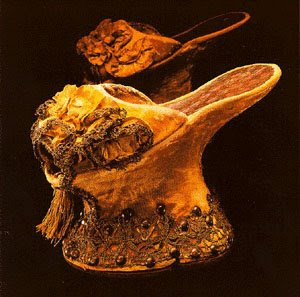
Chopines, circa 1500


Height as a way of life
This shoe style originally known as “chopines” was first popular among women in Italy, Spain and France. The style featured pedestals made of cork or wood and could have been as high as 24 inches. One extreme example known is of a Venetian lady whom while wearing chopines, needed two servants to help her in and out of her gondola. This example definately kept gowns from getting dirty from the mud - a sign of functionality. However, I see a bit of extremity in the height of the shoe which leads me to believe that at this time, people wanted some flair in their style.


A modern trend lending its style from history: The First High Heel and The D’Orsay, 1533
(shown: Manalo Blahnik, circa 2007)


Introduction of mainstream high heeled shoes
Catherine d’Medici, an Italian, married the Duke of Orleans at the age of 14. She was known to be of short stature and as such wore shoes with two-inch heels to exaggerate her height on her wedding. Her wedding style set off a trend for other shortly statured nobles across Europe. The Queen of England, who was also short in stature, is also thought to have made this trend en vogue.

As the high heel evolved, an interpretation of the heel included side openings that actually appeared in the 19th century English style, becoming popular in courts. Considered sensuous, the desire to expose skin on women’s feet led to the creation of the “d’Orsay” style. The d’Orsay is the style of shoe in which the vamp and sides are cut away to reveal the instep of the foot. The high heel is thought to have been invented by Leonardo da Vinci (1452-1519)

Pompadour Heels/Louis Heels 1638-1715


The Origin of the French Heel
At first, shoes with higher heels were made to allow ladies to walk high enough off the ground so that their skirts could be kept out of the mud. However, more than 100 years after Catherine de Medici first introduced high heels as a fashion statement, French heels were developed to help a man get over his Napoleon complex!
An example of an aristocrat using the style of his show to achieve greater height is King Louis XIV. King Louis XIV was a considered to be a short man. In order to achieve a height he considered reputable, he wore special high heels. The heels themselves were made of cork and also covered with dyed red leather. His shoes were painted with scenes from his military triumphs. Because of his influence, sometimes French heels are also referred to as Louis heels. They are five inches tall and bent so that they came down from the back of the heel, inward toward the shoe, and then outward away from the shoe for a winding look.

The influence of King Louis’ shoe choice can be seen today, but with modifications. Today, many French heels are made from plastic instead of cork. The upper part of the shoe is made of plastic, leather or fabric, while the sole is made of a hard plastic material. Some French heels have maintained the curved heel shape, but on a smaller scale.

Modern tech – circa 2008

Modern Heels
Modern day shoes have become taller then ever before, with 5 to 6 or even 7-inch heels and platforms. Besides the increase in height, designer shoes have inclined in expense. They range from $100 versions sold by brands such as Steve Madden to between $600 and $1,500 from designers such as Yves Saint Laurent, Marni, Manolo Blahnik and Christian Louboutin. Adopting characteristics from its ancestors, the modern shoe incorporates spiky stilettos, tapered cones, sloping wedges and thick wooden posts.

Sunday, February 22, 2009

This woman is wearing a draped sari, the traditional Indian attire for women. A sari is created by folding and wrapping 9 yards of fabric around the body.


(Left)
Roman draped fabric worn on both men and women.

(Right)
Elizabeth Taylor portraying the ancient Egyptian style of draping. However, this portrayal shows sewing techniques to imitate drapery.
Early 1900s men in tailored clothing, shown in long waist coats, mens stockings and general hats.

Left:

Mens tailoring. 1930s Long waistcoat design for gents. Designer: Callot


Right:

Mens tailoring. 1960s Wide leg garments for men.
Designer: Pierre Cardin

Friday, February 13, 2009

6 Functions of Dress: Why we wear what we wear


1) Group Membership


This is a Japanse boy band, the Teriyaki Boyz. They are diplaying their own fraternity style: Matching hooded sweatshirts and bleached, washed out denim. This style portrays their relationship to the urban, hip-hop community of the music industry they are a part of.


2005, Teriyaki Boyz


2) Environmental Clothing


My second example of dress was created with the use of elements of nature. The is a dress made of bark. Although the shape and form of the design has been inherited from the Ch'ing Dynasty, this is a Japanese dress constructed in the early 20th century. This form of dress is still worn in northern parts of Hokkaido, Japan by Ainu tribes.

The bark material is called attush fabric and it remains popluar in this region. Two main surface designs are presented here, applique and embroidery. The bark fibers were taken from elm trees.


Designer: Early 20th century, made by an Ainu native, owner is Robert Hemphill


3) Ceremonial Dress


This ceremonial dress is an example of a South East Asian bridal dress, or a lengha. The color red is quite condusive to the ceremony, as it is considered the traditional color for the bride.


The use of gold and silver threading by the designer further instigates the importance of this dress and the importance of the person wearing it. The use of this type of embroidery is borrowed from the Mughal Empire.

Designed by Manish Malhotra, 2007


4) Decorative Dress

This is an example of decorative dress that simply is used for branding purposes. The dress is being worn as type of statement to suggest a relationship between the wearer to the manufacter Burberry.

20th Century Design, Burberry (plaid design)


5) Sexual Enhancement: Body and Image


This is an image of Queen Mary I. She was aware of the fact that she could manipulate her image in society by her choice of dress. Therefore her style was large and more decorated; over time her fashion even incorporated extremely wide hemlines.


The widespread use of flamboyant ruffles made it difficult to eat, resulting in women splitting the ruffle in front so that it was easier to manage food, this technique also provided a frame for the wearer's cleavage. This dress form demonstrates the enhancement of the Queen's image as well as her body.


16th Century Europe, Queen Mary I


6) Gender Differentiation


This painting reflects the Middle Ages. It is easy to distinuish male and female figures, as well as their roles in society because of the symbolism of the dress choice.


Men are displaying form fitting pantyhose while the female characters are shown wearing flowing, long dresses. The knights are further distinguished by armory, while the nobility are adorned with accessories, such as crowns and rods which signify their respective power.


The male figure is adorned in a jaquette, or short camisole. This style replaced long tunics and was sometimes worn by those who were representatives of court during that era. The exposed legs of the the men were covered with leggings that had soles attached to each foot, so that shoes were not needed.


Painting, circa 1340, Northern France


Saturday, January 31, 2009

Fashion Source Book (fashun-sors-book): My interpretation of a fashion source book is a type of service (in this case online) that provides a guide to historical recreations of trends, social aspects of fashion and a overall guide that can hopefully lead to inspiration.


I have always been curious about the relationship that can be cultivated between architecture and shoes.